Autumn Fern Varieties and Cultivars Compared to Brilliance
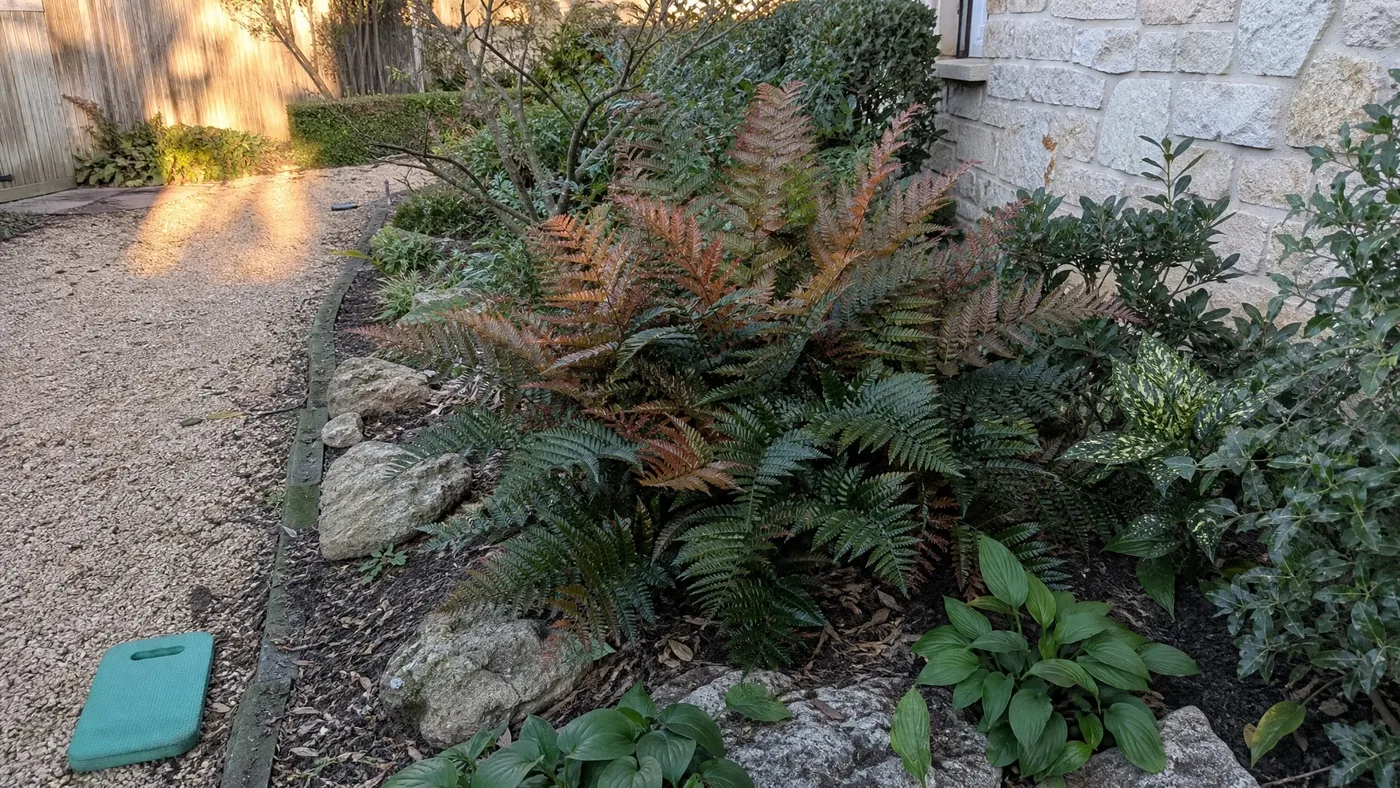
The "autumn" in autumn fern is a bit of a misdirection. Brilliance does its loudest work in spring, when new fronds unfurl red, drift to coppery pink and settle into dark glossy green by summer. The autumn part is quieter: orange-red spores on the undersides of the fronds and a wash of copper as the year turns.
That gap between name and behavior is why shoppers keep running into Prolifica, Koidzumiana, Jurassic Gold and Golden Brilliance and wondering whether any of them is really a different plant. Guess wrong and you can end up with the wrong size in a narrow bed, or a fern that was never meant for your winters.
Below, you'll find out all about how Brilliance sits among those sibling names, including how it behaves in a narrow side bed, dry shade, a cold yard, a hot-deck pot, a prominent front walk and a mixed fern bed, plus how to read the tag on any cousin.
A Side Bed Barely Wider Than a Doorway
The strip between house and fence is where we hear the most sibling-name questions, because width decides everything in a space this tight. Here is how Brilliance fits.
Clump, not carpet. Brilliance is clump forming and has an ultimate height and spread of 0.5 to 1 meter, which is about 1.5 to 3 feet each way. Picture a fountain of arching fronds rather than a ground cover marching along the wall. In a 3-foot strip it fills the width at maturity and stops.
Give it time. Time to maturity is 5 to 10 years, so a young plant looks modest in the strip for a while. Resist squeezing three in where one belongs. Space to the mature width and let a layer of mulch cover the gaps while the clumps fill out.
Use the evergreen line. Brilliance is evergreen, so the foundation keeps a green edge through winter, which counts in a bed you see from the kitchen window. Stagger the plants so fronds overlap like roof tiles instead of standing in a row. Our guide to how big Brilliance really gets has the full size picture.
If a sibling name has caught your eye for this strip, read its tag for mature width first. The sources we trust publish no figures for Prolifica, Koidzumiana, Jurassic Gold or Golden Brilliance, so we will not borrow numbers for them.
Dry Shade Under a Big Tree
Few spots are harder than the ground beneath a mature maple or oak, where roots take the water and the canopy takes the light. This is where Brilliance earns its place.
What we know. Brilliance is easy to grow in cool, moist, lightly shaded sites and is tolerant of dry shade, with regular watering in the first season. That detail separates it from the general description of the species, which likes acidic, constantly moist soils high in organic matter.
How we read the two. Treat dry shade as survivable, not ideal. The first season is the investment: water on a schedule so the roots get established before the tree competes for every drop. After that, the fern holds its dark glossy fronds with far less fuss than most shade plants, and you can mostly leave it alone.
Soil is forgiving. The species itself prefers acid soil (below pH 6.0), while Brilliance suits acid, alkaline or neutral soil, and moist but well-drained, poorly drained or well-drained ground. Under a tree you will rarely get to choose anyway. Work in leaf litter or compost where you can without cutting big roots, and see our soil guide for the details.
A Cold Yard at the Edge of the Range
Hardiness is the question behind most searches for cultivar names, and it is the one where sources give us the least to work with. Here is what is actually known.
Hardiness Ranges
The numbers come from different places, so it helps to see them side by side before you plant.
For USDA zones we only have species figures, and they disagree: NC State lists 6b through 12b, while UF/IFAS says 5 through 11. Since the cold edge is a judgment call, ask your local extension service about your own winters.
Planting at the Cold Edge
If you are near the bottom of those ranges, small choices add up.
Pick a sheltered spot, such as the lee of a wall or house, and keep the soil evenly moist going into winter. Evergreen fronds can look battered after a hard season, so plan on tidying them as the new red growth begins. Our winter care guide walks through it. Do not assume Prolifica or Koidzumiana share Brilliance's tolerances. Check each tag for a USDA zone.
A Pot on a Hot Deck
A container by the back door gives you the color up close, and it changes the rules about light and water. Here is how Brilliance handles it.
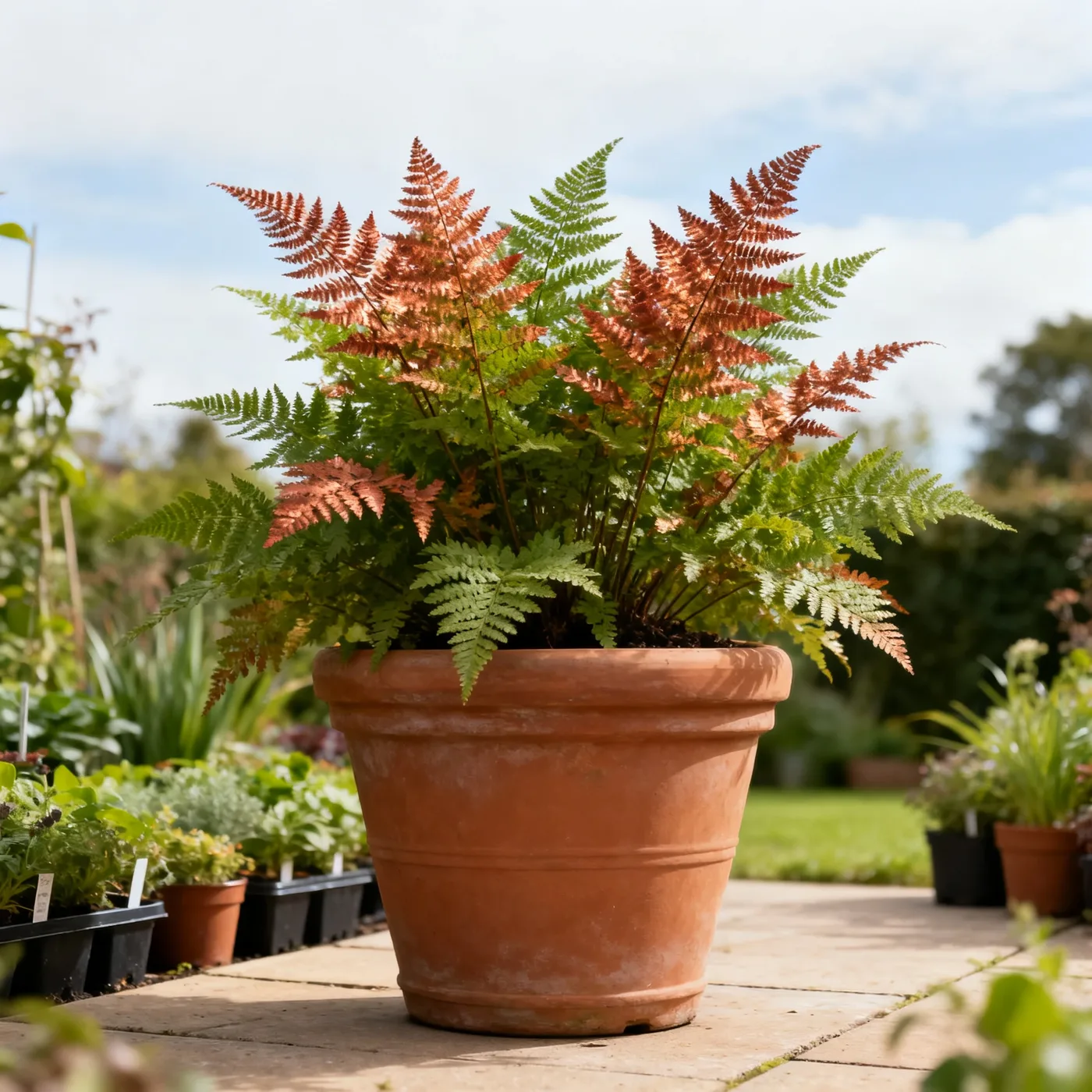
Common advice says autumn ferns need deep shade, and for Brilliance that is too strict. It suits full shade and partial shade, and it will grow in full sun if given plenty of moisture. The condition is the key: moisture. On a hot deck a pot dries far faster than a bed, so the sun is not the problem. A thirsty root ball is.
Start with the right pot. Brilliance takes 5 to 10 years to reach its mature size of up to about 3 feet, so a pot that is large enough to buffer moisture and wide enough for arching fronds will last years before it needs more room. Heavy pots hold water longer and resist tipping when the fronds fill out.
Check the soil, not the calendar. Push a finger in. If the top inch is dry in summer, water deeply. Keep the pot off a reflecting wall if you can, and move it toward the morning side of the deck when heat waves hit. Our guide to growing Brilliance in pots covers repotting and winter placement.
The Front Walk Everyone Sees
A fern beside the front path gets judged on color alone, and this is where Brilliance outshines the plain species. Here is the sequence you will see through the year.
Spring is the show. New fronds are red, then turn coppery pink and then dark glossy green. The new growth also shows bright orange-red, copper-pink and chartreuse. In our rows, that flush is what stops people mid-aisle. Put the clump where you pass daily, because the best color lasts only a few weeks.
Then comes the quiet part. By summer the fronds are a dark, glossy green that works as a calm backdrop. In fall, the fronds take on coppery tones, and orange-red spores show on the undersides of the leaves. You will not get a blazing fall display. You get warm, subtle accents.
Evergreen versus semi-evergreen. The species is only semi-evergreen to about 75 centimeters, roughly 30 inches, with young fronds that are often coppery pink. Brilliance is listed as evergreen, with red new fronds, so the front walk stays green longer. Our species comparison covers that in detail.
For pairings, a dark green fern reads best against blue-green or variegated foliage, so the spring red stands out as the accent.
A Mixed Bed With More Than One Fern
Some gardeners want a drift of several cultivars instead of one repeated clump. That works, but a few habits keep it from turning into a muddle.
Repeat before you vary. Plant Brilliance in groups of the same plant so the red spring flush reads as one wave. Mixing in a sibling like Jurassic Gold or Golden Brilliance can add contrast, but we would want to see each one in your light for a full year before we promise how it will pair. Note when each opens in spring and how it looks in winter.
Match the needs. Anything you combine should share Brilliance's preference for cool, moist, lightly shaded ground. A fern that wants drier or brighter conditions will sulk beside it, and one that spreads aggressively will crowd it out.
Space for maturity. With a mature width of up to about 3 feet and a 5 to 10 year path to get there, a bed looks sparse for the first few seasons. Fill the gaps with a mulch layer, not extra ferns.
Make more of what works. Brilliance can be propagated from spores or by division in spring. Our guide to dividing Brilliance shows how to turn one good clump into a repeating pattern across the bed.
Sorting Sibling Names Before You Buy
Searches for Prolifica, Koidzumiana, Jurassic Gold and Golden Brilliance keep landing on our pages, so here is the honest answer on how to compare them with Brilliance.
What We Can and Cannot Say
Our growers speak for the plant we know, and the sources we trust back only that plant.
Those four names circulate alongside Brilliance under Dryopteris erythrosora, but the sources we rely on publish no dependable height, width, color timing or hardiness for them. One of the most common questions we get is whether Golden Brilliance is simply Brilliance under another label. We cannot confirm that from any source we trust, so we ask you to check the tag.
What to Check on Any Tag
The table below lists what we know for Brilliance and what to ask of a cousin before you swap it into a plan.
| Trait | Brilliance | Ask of a sibling |
|---|---|---|
| Mature size | About 1.5 to 3 feet tall and wide | Height and spread in feet |
| Habit | Clump forming | Clumping or creeping |
| Winter foliage | Evergreen | Evergreen or semi-evergreen |
| Hardiness | Species USDA ranges | A USDA zone |
| New fronds | Red, then coppery pink, then dark glossy green | Color and timing of the flush |
Matching the Fern to Your Yard
Each yard above points to the same answer: Brilliance is a compact, clumping, evergreen fern with a red spring flush, forgiving in dry shade and happy in a pot if you keep it watered. It needs 5 to 10 years to fill out, so plant it where it can stay.
Brilliance Autumn Fern
Nursery-grown Brilliance Autumn Fern in sizes from 4 Inch, shipped to your door.
From $16.99
Shop Now →When a sibling name tempts you, hold it to the same checklist for size, winter foliage and hardiness. Where the tag stays silent, ask the seller or your extension service. Every Brilliance we ship is potted in its own container and packed so fronds and roots arrive intact and ready to plant, and as growers with our own farms we stand behind the plant we know best.