Brilliance Autumn Fern vs Dryopteris Erythrosora: Key Differences
If you're shopping for an autumn fern to fill a shaded corner, you'll likely encounter two options: Brilliance Autumn Fern ('Brilliance') and the straight species Dryopteris erythrosora. Both are evergreen to semi-evergreen ferns from the same plant family, and both thrive in woodland gardens and shade borders. But they're not identical. The question is whether the cultivar's distinctive traits justify the slight difference in price or availability, or whether the species performs just as well in your garden.
This guide walks you through the real differences, helps you weigh the tradeoffs, and shows you which one fits your specific landscaping goals.
What They Have in Common
Both Brilliance Autumn Fern and the species Dryopteris erythrosora share a core identity. They belong to the same botanical species, Dryopteris erythrosora, and carry the same horticultural fundamentals:
- USDA hardiness zones 5-9
- Evergreen to semi-evergreen behavior (retaining fronds through winter in milder zones; semi-evergreen toward zone 5)
- Triangular, finely divided (2-3 pinnate) fronds with a glossy finish when mature
- Part shade to full shade preference
- Medium, consistent moisture requirements; not drought tolerant
- Acidic to neutral soil (roughly 5.5-6.5 pH) with organic matter
- Deer and rabbit resistance
- Long-lived perennial lifespan (commonly 10+ years with proper care)
- Low toxicity to pets and people
Both are also slow to moderate growers. They reach their mature clump size in about 2 to 3 years, adding roughly a few inches of new frond growth annually. If you're expecting a fern to fill a space quickly, either cultivar will test your patience initially.
Key Differences Between Brilliance and Species Dryopteris Erythrosora
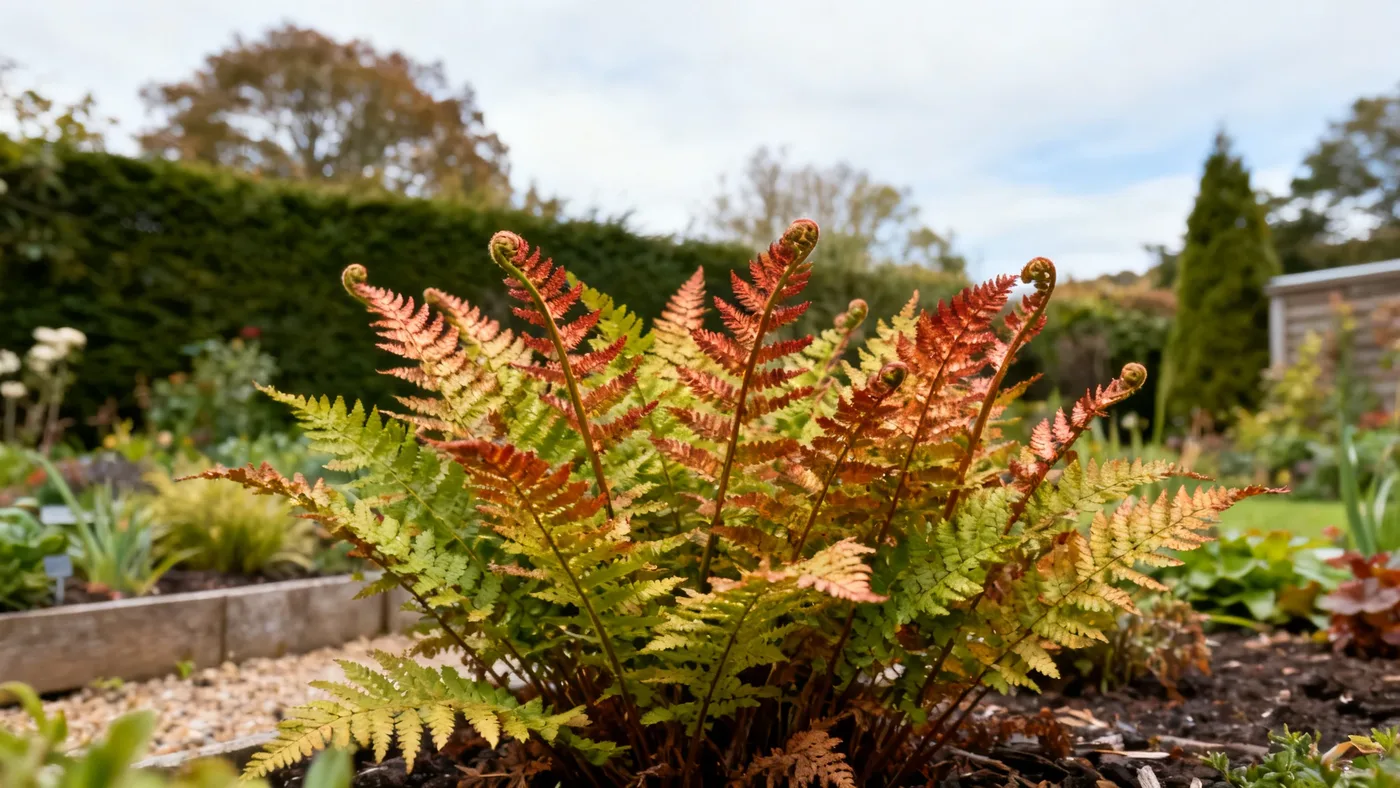
The cultivar 'Brilliance' was selected from the species for one primary characteristic: a more pronounced and persistent copper-red to bronze tint in its new spring growth. This is where most of the visible distinction lives.
| Attribute | Brilliance Autumn Fern ('Brilliance') | Species Dryopteris Erythrosora |
|---|---|---|
| New frond color | Pronounced coppery-red to bronze, very prominent in spring | Reddish tint present but often more subtle |
| Mature frond color | Glossy dark green | Glossy dark green |
| Mature height | 18-24 inches (up to 2 ft in ideal shade) | Typically 18-24 inches; some sources cite similar range |
| Mature width | 18-24 inches, slowly spreading clump | 18-24 inches clump (typical) |
| Growth rate | Slow to moderate | Slow to moderate |
| Time to maturity | 2-3 years to full clump | 2-3 years to full clump |
| Cold hardiness | Zones 5-9 (semi-evergreen in zone 5) | Zones 5-9 (semi-evergreen in zone 5) |
| Winter appearance | Retains fronds; may bronze in cold weather | Retains fronds; may bronze in cold weather |
| Availability | Increasingly common in specialty nurseries | Widely available at general nurseries |
| Pest/disease resistance | High deer resistance; occasional slugs or scale | High deer resistance; occasional slugs or scale |
Foliage: Where the Cultivar Stands Out
If foliage drama is your priority, Brilliance Autumn Fern delivers a more vivid spring display. Each year, when new fiddleheads unfurl in spring, the 'Brilliance' cultivar produces fronds with a striking coppery-red to bronze hue. This intense coloring can persist for several weeks before the new growth hardens off and transitions to that glossy dark green. In a shade garden dominated by hostas and heuchera, that spring flash of warm red tones adds seasonal interest that the species version conveys more subtly.
The species, by contrast, also produces reddish new growth, but the tint is often less vivid and less sustained. For gardeners who value year-round foliage interest in shade, this difference matters. The 'Brilliance' cultivar essentially gives you a predictable burst of warm color twice a year (spring emergence and, to a lesser extent, when new fronds emerge in fall).
Once both ferns mature and settle into mid-season, the visual difference closes dramatically. Both show that same glossy, deeply divided dark green that makes autumn ferns such reliable shade performers.
Size, Growth Rate, and Garden Placement
In terms of footprint, there is no meaningful difference. Brilliance Autumn Fern matures to 18-24 inches tall and 18-24 inches wide, forming a slowly spreading clump. The species matches this profile. For spacing in mass plantings, both cultivars warrant 18-24 inches between plants to allow for mature width.
The slow growth rate is a shared trait. If you're planting a shade bed with ferns this spring, don't expect them to meet in the middle for at least 2 to 3 years. Plan your layout accordingly, or space them closer initially and be ready to thin later. This is not a weakness specific to 'Brilliance'; it's simply how the species (and most ferns) grow.
Hardiness, Winter Behavior, and Regional Fit
Both ferns hold the same hardiness range: zones 5-9. In zones 6-9, both are fully evergreen, retaining their fronds through winter and providing structure and interest in the dormant season. Toward zone 5 (colder northern climates), both transition to semi-evergreen behavior, meaning they may flatten, brown, or lose some fronds in harsh winters but typically recover from the crown in spring.
There is no evidence that one cultivar is hardier than the other. If you garden in zone 5 or the colder reaches of zone 6, you'll treat both the same way: cut back any winter-damaged or tattered fronds in late winter to very early spring, before new fiddleheads emerge.
Pros and Cons
Brilliance Autumn Fern ('Brilliance') Cultivar
Pros:
- Dramatically colored new spring growth (coppery-red to bronze), adding seasonal foliage interest
- More distinctive ornamental appeal for shade borders and specimen plantings
- Same proven hardiness and low-maintenance care as the species
- Growing availability through specialty and online nurseries
- Excellent for gardeners seeking cultivar-level refinement without complexity
Cons:
- Slower to find at general big-box nurseries
- Slightly higher price than species stock
- No hardier or faster-growing than the species; foliage color is the main advantage
- New growth color fades as fronds mature, so the effect is seasonal, not year-round
Species Dryopteris Erythrosora
Pros:
- Widely available at mainstream nurseries and garden centers
- Typically lower cost than the 'Brilliance' cultivar
- Same excellent hardiness, lifespan, and shade performance
- Subtle reddish tint in new growth adds understated elegance
- Proven track record in gardens for decades
Cons:
- Less dramatic foliage color in spring; reddish tint is more muted
- If you want maximum ornamental impact from new growth, the cultivar outperforms it
- No practical advantage in hardiness or vigor over the cultivar
Which Should You Choose? Best For Recommendations
Choose Brilliance Autumn Fern ('Brilliance') If:
- You want a focal-point fern with distinctive seasonal color that catches the eye in spring
- Your shade garden includes hostas, hellebores, and astilbe, and you want a fern that contributes dramatic warm tones alongside those companions
- You're planting a specimen fern near a patio or entryway where the new growth will be visible and appreciated
- You prefer a named cultivar selected for ornamental merit over generic species stock
- You're willing to seek out a specialty nursery to get the exact look you envision
- Your primary goal is foliage color and texture, and you want the most visually distinctive option
Choose Species Dryopteris Erythrosora If:
- You need ferns for a large mass planting or groundcover swath and want to keep costs reasonable
- Your local nursery has species stock in stock today, and you prefer to plant now rather than source the cultivar
- You appreciate subtle foliage color shifts and don't need high ornamental drama
- You're planting a naturalistic woodland garden where consistent, reliable performance matters more than cultivar distinction
- You want the proven reliability of a species that has performed well in gardens for many years
- Budget is a primary constraint
Caring for Either Fern: No Real Difference
Once you bring either fern home, care requirements are identical. Both need part shade to full shade, medium consistent moisture (especially in the first year), and organically rich, well-drained soil with a pH around 5.5-6.5. Both respond well to a light spring application of balanced, slow-release fertilizer and an annual top-dress of compost or leaf mold. Neither has demanding pruning needs; you simply cut back winter-damaged fronds in late winter before new growth emerges. Both pair beautifully with hostas, heuchera, astilbe, hellebore, Japanese painted fern, brunnera, and pulmonaria.
For detailed care instructions, see our Brilliance Autumn Fern care guide.
The Verdict
Brilliance Autumn Fern and species Dryopteris erythrosora are fundamentally the same plant at heart. They share hardiness, size, lifespan, and low-maintenance culture. The 'Brilliance' cultivar's competitive advantage is purely visual: a more vivid coppery-red to bronze flush in spring growth. Whether that seasonal color boost justifies seeking out the cultivar comes down to your garden's design goals and your tolerance for a slightly longer hunt and higher price.
For gardeners building a shade border with strong foliage color play, 'Brilliance' is the smarter choice. For large plantings or budget-conscious landscapers, the species delivers equal resilience at lower cost. Neither is "better" in absolute terms; they're different tools for different jobs.
Quick Reference Comparison Checklist
| Factor | Brilliance 'Brilliance' | Species | Winner |
|---|---|---|---|
| Spring foliage color | Vivid coppery-red | Subtle red tint | Brilliance |
| Mature foliage color | Glossy dark green | Glossy dark green | Tie |
| Hardiness | Zones 5-9 | Zones 5-9 | Tie |
| Mature size | 18-24 in H/W | 18-24 in H/W | Tie |
| Growth speed | Slow to moderate | Slow to moderate | Tie |
| Time to maturity | 2-3 years | 2-3 years | Tie |
| Cold hardiness | Zones 5-9 | Zones 5-9 | Tie |
| Availability | Specialty nurseries | Widely available | Species |
| Price | Higher | Lower | Species |
| Care requirements | Identical to species | Identical to cultivar | Tie |
| Deer resistance | High | High | Tie |